
Models for an empty Debenhams: Shredenhams

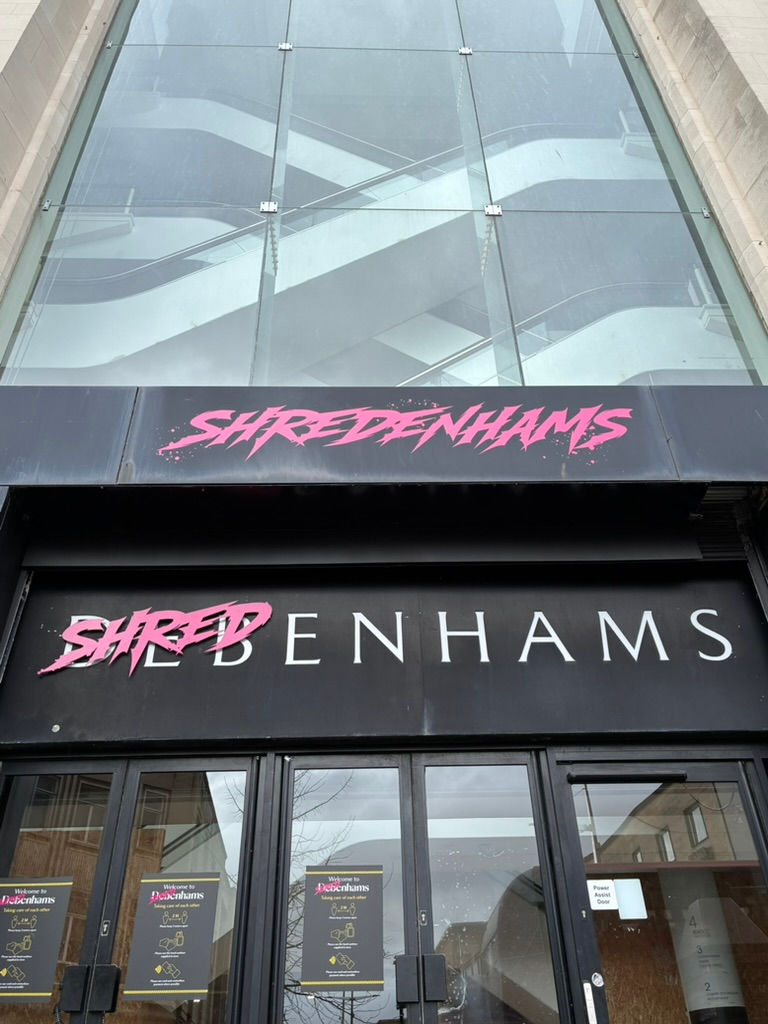
An interview with Ben Stephenson & Tim Nokes, Campus Skateparks.
In the early part of this century, scores of town centre developments were being anchored by a Debenhams department store. Despite the 2008 crash, such developments were opening as late as 2017, when the company was already steering into trouble following what is now accepted as a hubristic overexpansion.
The private equity consortium that owned the company stripped £1.2bn off dividends, saddling the company with over £1bn of debt. Property was sold and leased back to raise ready cash, but maintenance and recruitment fell by the wayside. When trading conditions changed with the 2017 rates revaluation and later COVID, 200 years of trading on the high street came to an end in 2021 with the sell-off of the brand to online giant Boohoo.
Alongside the loss of 12,000 jobs, 120 stores closed, leaving town centres with their latest high street headache. In 2026, most of these stores remain empty.
We are over the worst of the latest high street crisis now, with footfall up and store closures and vacancy reducing. An entrepreneurial spirit is returning to the high street, with empty department stores offering an opportunity to ambitious companies keen to try out new models and meanwhile uses.
In the centre of Bristol, within a minute’s walk of each other, are three former large-format stores, each being busily reinvented. the former Wilko is now a hugely popular climbing centre and café. The former Marks and Spencer is Sparks, run by Artspace Lifespace and the Global Goals Centre as a community hub, retail, coworking and events space. A gleaming new M&S has opened nearby.
Opposite Sparks is Shredenhams, a skate space and café occupying the ground floor of the former Debenhams as a three-year meanwhile use. Quickly becoming central to Bristol’s skateboarding scene, Campus Skateparks has provided a space that brings young people into town again. It is one of a number of viable models for the meanwhile – and perhaps permanent – use of some of the UK’s crumbling department stores.
Below is an interview taped in. March 2026 with Campus’s Tim Nokes, one half of the company. I am grateful to him for the time to explain the company’s model and ambition.
Ben: Can you take me back to the beginning? How did Campus start?
Tim: We kind of fell into a sweet spot mopping up unused spaces owned by local authorities. The first big one was a college site, connected to Artspace Lifespace – it had low rent, all‑inclusive fees and loads of restrictions, but it was a brilliant incubator. There were loads of creatives: carpenters, jewellery makers, the Invisible Circus – people with ideas but no money to get them off the ground.
Around 2013 we moved up to Winterbourne in South Gloucestershire and got the lease on an old youth centre through a competitive community asset transfer process – essentially rent free as long as you're of worth to the community. As soon as we were in there, we started trying to get hold of the old swimming pool in Bishopsworth in South Bristol.
We got that building a couple of years later and opened it in 2016, which was very real – borrowing six figures and spending a lot, whereas everything before had been more DIY, no debts, no regrets.
Running two venues was more than we'd bargained for. We had years of just stabilising and learning how to operate both.
Ben: How did Covid affect you?
Tim: Covid was a massive pause and a hard reset – devastating for the business, but mentally and structurally really good. Because we're a not‑for‑profit, most of our income comes through salaries not dividends, so we could furlough staff and apply for grants. We refinanced our loans, reinvested everything we could and came back post‑Covid with a much stronger vision of what we wanted to be.
From reopening around 2021 through to last year has been the most business‑focused period we've ever had, and that's what led to this Debenhams opportunity.
Ben: So how did you end up in this former Debenhams?
Tim: The owners are AEW, with Hartnell Taylor Cook as managing agents. James Woodward from Hartnell Taylor Cook was bringing his kids to skate lessons at the pool and just got it – he'd seen what we'd done with empty buildings. One day he emailed saying, "I'm in one of your buildings. You're clearly good at taking on empty space. Are you interested in another empty property I'm managing?"
I actually sat on that email for three days thinking, "There's no point replying, this is impossible – how do I say no?" Eventually I thought I should at least meet him and look at the building. I came here on my own at first because it seemed too crazy to even tell the rest of the team.
The building had been completely stripped out and made ready for demolition – no walls, very minimal services. AEW's initial plan was a 24‑storey mixed‑use scheme with lots of student accommodation, some retail, hospitality, commercial and around 10% community space to meet council policy. That project stalled – planning, funding, ambition, all the usual – and the building just sat there.
For us the key was that the landlord had to work with us and, crucially, go "backwards" from demolition‑ready: they had to reinvest and put services back in so we could operate.
Ben: What does your lease look like here?
Tim: Officially it ends on 31 March 2027, so just over a year away. But even in this one‑year extension they can serve notice if they want to kick off their project – we signed a fairly one‑sided deal initially where we only had six months' real security. They seem very happy with how we're managing the building and the public‑facing role we have here, but there's always that underlying risk.
Ben: Developers can get nervous about popular community uses because of the campaign that can ensue when they want their building back. Are you worried about that?
Tim: Yeah, you could sense that caution in early negotiations. Charlie, the person at AEW ultimately in charge of the property, even came and did a mystery‑shopper building inspection without saying who he was. Apparently we passed, but I'd love to bend his ear about future properties and what they really think of us.
When you run your own thing you rarely get a pat on the back, so getting one from someone "above you" feels good – and it helps open conversations about future projects.
Ben: Can we talk about your model, and then about how it might scale?
Tim: The beauty of our model in a department store‑type space is that it doesn't take a huge investment to make something amazing. We need the right floor, high enough ceilings, and pillars that aren't too painful – then we build everything else ourselves. It's like staging or dressing a building.
We also flip a usual liability – huge floorplates – into a big positive. On some days it looks and feels busy and vibrant, but I'll look at the till and want to cry – which is actually brilliant from a place‑making perspective. Five skateboarders, two pool tables, a couple of booths, music and lights – fewer than 20 people – and the place feels alive.
Ben: How does this sit alongside the ecosystem – the other skate spaces in the city?
Tim: It's very popular compared to other Bristol spaces, but we've always been mindful not to cannibalise our own venues. We gave each site its own USP and we try not to worry about "competition" because we need the whole scene to grow – participation is still tiny compared to football or even climbing. Outdoor parks and other indoor spaces help make skateboarding more accessible and feed into what we do.
We always present Shredenhams as a skateboarding space first, even though we allow BMX, scooters and roller skates. That gives us credibility and keeps us rooted in the culture.
Ben: You also run a pub, right?
Tim: Yeah, we set up The Dame at the bottom of the south Bristol skatepark – same people, different business. It was a passion project and it's doing really well as a business; it's a lovely building and location with a diverse, very "Bristol" crowd and great music. Andre was fully visionary on that one.
We do serve alcohol in the skatepark too, but we're careful about balance. It's a reflection of life – people can be healthy, skate, drink water, and also enjoy a beer and a party sometimes. If you try to sanitise all of that – say a straight‑edge only venue – you lose the countercultural edge.
Our focus is never "being a bar"; skateboarding is always the driver. But alongside that we'll have, for example, Clear Head alcohol‑free beer on tap and promote men's mental health groups linked to that brand – it's a yin‑yang thing.
Ben: What do you actually do around support for young people – on‑ and off‑site?
Tim: We've always avoided calling ourselves a youth centre; we're a skatepark that naturally attracts young people, then we wrap a lot of youth‑work around that. On‑site, schools can book alternative PE sessions, we run mentoring for kids at risk of exclusion, and we do holiday clubs where parents drop off at 10 and pick up at 4.
Holiday clubs are paid for privately, but at both our north and south sites we have small pots of money so children on free school meals can attend for free and get a hot meal, and we're applying for more funding. Off‑site, we run after‑school clubs in between five and ten schools at any time, with some paid places and some free‑school‑meal places built in. Those clubs flow nicely into the free holiday programmes with the same staff, and no one knows who's paid or not.
Parents paying for clubs is just how you expose kids to different activities these days – I do it for my own kids too. We're working every angle we can to reach as many people as possible.
Ben: There's a lot of talk about making space for girls and inclusive public realm. Day one here, the queue was all boys – was that a worry?
Tim: It's a fair concern; skateparks have been boys' clubs for years. Covid changed things: when everything else was shut, people realised you could just go to a car park on your own and skate, and that opened it up across genders and backgrounds. People discovered it's fun, cheap, and something you can start alone and then build a community around.
I don't have the stats in front of me, but I'd put money on after‑school clubs now being around 60% female. Girls seem more comfortable with the slow, steady grind of learning; scooters give a quicker "high" and boys often chase that and have bigger accidents.
We take gender seriously, but there's also a natural shift happening. We're connected to people like Bella at Skateboard GB, who used to be our youth and inclusion worker and now helps design skatable spaces, thinking hard about how to break down design barriers for women and girls.
Ben: A lot of my work seems to suggest young people are cut off from conversations about their cities. Do you see yourselves as giving them a stake?
Tim: Definitely. Having a facility specifically for young people in the city centre is crucial – especially if you want them to feel like custodians of these spaces, not just visitors.
But we like doing things low‑key and "through the back door". We'll do youth work, give young people a voice and run all the classic youth‑centre‑type activities, but we'll never badge ourselves as a youth hub; we'll always present as a skatepark doing skate events.
I also feel like we're in a golden yet fragile bubble right now. Skateboarding is still niche and underground while also being Olympic and mainstream – parents call me asking about lessons for their three‑year‑olds. I don't know where it goes next, but I'll always fight to keep us close to our roots even as big brands and governing bodies move in.
Ben: I'm particularly interested in department stores like this one as a typology. Debenhams, for example, was heavily anchored into town‑centres via pension and investment funds, still opening big new stores as late as 2018 while saddled with debt – it was a slow‑motion collapse that became symbolic for the decline of high streets.
What fascinates me about your model is the ratio of space to investment: lots of space, not that much fit‑out cost. Other re‑use models for department stores include university lecture theatres or markets, but they can be capital‑heavy. You've shown you can "dress" a building quickly and create vibrancy without huge spend, which is hugely attractive to landlords and cities.
Exactly – we build everything in a space like this ourselves. As long as the fundamentals are right, we can turn a big empty floorplate into something that feels full of life.
Ben: If other towns or cities want a Shredenhams what conditions have to be in place?
Tim: There are a few essentials. First, the landlord and local authority – they have to genuinely want a social use and be willing to fix structural and compliance issues, plus ideally offer rent‑ and rates‑free terms.
Second, the local skate ecosystem. In Birmingham, for example, we looked at a Marks & Spencer's. We immediately went to the local skate shop and found there was already a scene, maybe a CIC, some outreach work – potential partners. We'd likely have been the leaseholder because we're a bigger, trusted organisation, and they'd help operate and staff it – almost a franchise partnership.
But the owner already had a tenant willing to pay full rent, so it was a non‑starter – we're not interested in competing for buildings with market‑rate tenants. We were very clear: we need rent‑free, rates‑free, and for them to sort major building problems; somehow that got misunderstood.
Bristol is pretty unique. It's very open to this kind of project and there's a strong existing scene. Smaller towns can find the idea of giving big central spaces over to young people quite daunting; I get that. You can't just pitch up anywhere – if there's no skate scene it's a hard sell, and if there's already three great parks you might just displace someone rather than add value.
Scaling ourselves into another city would be a huge amount of work each time. And culturally, as soon as we arrive in a new city some people will see us as "the corporate lot", even though you can see by this office and how I'm dressed that we're anything but. But we’re up for the challenge.
Ben: What's your ideal scenario from here?
Tim: First, I don't want this project to die when the lease ends. I'd love us to find a new home in Bristol, ideally on our terms – where we give the landlord notice because we're moving onto something bigger and better, rather than them serving us notice. It would be great to be in a position where they're saying, "Please stay – we'll have to pay service charge if you go."
Second, we're open to looking at other spaces in Bristol and other cities – whether that's us directly operating, partnering locally or coming in as consultants to help others get the structure right.
Tim Nokes can be contacted on tim@campusskateboarding.com
Ben Stephenson can be contacted on ben@basconsultancyhome.co.uk


Utilizar os recursos fornecidos por lojas confiáveis pode aumentar significativamente a precisão da medição e melhorar a men's average pinky ring size experiência de compra. Outra técnica bastante utilizada para medir tamanho de anel online envolve o uso de um barbante ou fita métrica flexível.
Understanding market conditions is essential when deciding where to sell precious metals in NZ. Precious metal prices how to tell if jewelry is gold fluctuate daily based on global economic factors, currency movements, supply and demand, and investor sentiment.
Cameras can also help identify signs of gutter damage, such as cracks, sagging sections, or separated joints. By combining how to clean out gutters you can't reach in ontario inspection and cleaning capabilities, these tools provide greater confidence that the entire gutter system is functioning properly.