
// What is the Future for High Streets?

In the context of the announcement of HM Government's upcoming High Street Strategy, High Street expert BEN STEPHENSON considers how high streets need to adapt to stay relevant to the country's changing needs, arguing that our communities need more than just retail therapy.

Our sector hasn't been terribly effective at countering the failing high streets narrative, but to say it again: Britain's high streets are more than just shopping centres.
In the last two decades, the conversation around these essential gathering places has been dominated by narratives of decline, closure, and abandonment. Shuttered shopfronts have become symbols of economic hardship in many town centres across the country.
But is this the complete picture? After 25 years of working directly with high streets, local authorities, community groups, and business leaders, I have observed something far more nuanced and, in many cases, more hopeful. Yes, many high streets face genuine challenges, but they’re also undergoing profound and often inspiring transformation.
This article explores what we have learned about the future of high streets: the complex factors driving change, the emerging opportunities we are witnessing, and the practical steps communities can take to create vibrant, resilient places that reflect their values and serve their people.
What makes a successful high street?
High streets and town centres are living reflections of the communities they serve. When they function as they should, they represent far more than economic output. They embody a sense of local identity, engender civic pride, and create a genuine sense of belonging among residents.
The value they deliver extends well beyond retail. In addition, successful high streets:
Generate social connection and community cohesion
Provide opportunities for wellbeing and mental health through public gathering spaces
Nurture skills development and innovation through diverse business ecosystems
Support local employment and economic resilience
Create spaces where people feel invested in their community's future
But creating these conditions requires far more than good intentions. It demands skilled management, clear vision, and a sophisticated understanding of the delicate interplay between infrastructure, place management, economics, and sometimes, let's be honest, a degree of luck.
The complexity of high street performance
One of the most important lessons we have learned is this: there are no simple answers when it comes to high street success or decline.
High street performance is inherently, infuriatingly complex and must be understood both at a local and structural level. What works brilliantly in one place may fail entirely in another. Context matters enormously. The demographics of the catchment, the local economy, the quality of local leadership, the property ownership structure, and even the architectural heritage of the place all play crucial roles.
This complexity explains why high streets do not follow straightforward trajectories of growth or decline. Instead, places tend to succeed and fail in circular motions across decades. A struggling high street might stabilise through new investment and community energy, only to face fresh challenges when anchor tenants close or new out-of-town developments open. Understanding these cyclical patterns helps us approach high street regeneration with pragmatism.
Redefining success
For too long, we have measured high street success by comparing them to ’ideal’ examples: Richmond, Cirencester, Bath. These are undoubtedly prosperous and vibrant places, and they deserve celebration. But they are also home to wealthy catchments with significant spending power.
This creates a troubling misconception. If we view only wealthy high streets as "successful," we miss a crucial insight: a high street that authentically reflects the demand and income of its catchment is, by definition, successful.
A high street in a lower-income area that serves its community's genuine needs, provides employment, and creates spaces for social connection is performing its function effectively, even if it does not have the same mix of designer shops and fine dining as an affluent town. This perspective shift is crucial for helping communities avoid the demoralising experience of comparing themselves unfavourably to places with entirely different economic contexts.
It also serves as a reminder to those in the placemaking sector that attempting to create places according to their own consulmer desires rather than reflecting those of the local catchment does that community and economy a disservice.
The out-of-town effect: as big as online
Much of the recent conversation about high street decline focuses on the rise of e-commerce. Online shopping has undoubtedly changed retail patterns, and we can expect continued decline in traditional clothing, homewares, and electronics shops as online shopping becomes increasingly efficient and convenient.
But here is what our experience and the evidence tells us: out-of-town retail has impacted the high street as much as online shopping has.
The development of shopping centres and retail parks in the decades after the 1980s fundamentally altered consumer behaviour and investment patterns. While online retail is now accelerating the decline of certain sectors, the basic template of the high street as a one-stop shopping destination was already disrupted by out-of-town alternatives.
Understanding this distinction matters because it points us towards solutions. At government level, changes to the planning system’s sequential test are being suggested in favour of town centre development. The 2025 budget shifted the business rate tax burden much more towards out of town and online fulfilment centres. At a local level, there are signs that the changing high street is proving more attractive to retail again.
The diversification revolution
And this is where the story becomes genuinely exciting. High streets are diversifying in remarkable ways.
Increasingly, UK high streets play host to a far wider offer than traditional retail. Hospitality venues (cafés, restaurants, breweries) are becoming anchors that draw people for experiences rather than goods. Education providers, cultural venues, community health services, and civic spaces are all finding homes on high streets.
This diversification is not simply replacing what was lost. It is fundamentally strengthening the resilience of high streets. When a high street combines retail, food and drink, cultural activity, and community services, it creates reasons for different people to visit at different times throughout the day and evening, linking trips to prolong ther visit. A parent might pop in to a café after the school run, a young person might visit an educational venue in the afternoon, and couples might choose restaurants for an evening out after work.
This temporal and demographic diversity proved invaluable during the pandemic, when some high streets with diverse uses recovered faster than those dependent solely on retail.
The (unjustifiably controversial) 15-minute city concept, where residents can meet most of their daily needs within a short walk of home, is driving more intensive town centre housing development. As more people live in town centres, the natural demand for services, amenities, and social spaces grows, creating a sustainable market for diverse high street uses.
Of course, some of this changing demand is creating diversification that is not so obviously good for community cohesion. Examples include the proliferation of dark kitchens (closed premises which act as central hubs for take away delivery operations) alongside the gig economy that supports them, and the growth of uses in retail units which serve in effect only to avoid tax, such as 'urban snail farms' and unused places of worship are examples.
Repurposing the ‘cathedrals of consumerism’
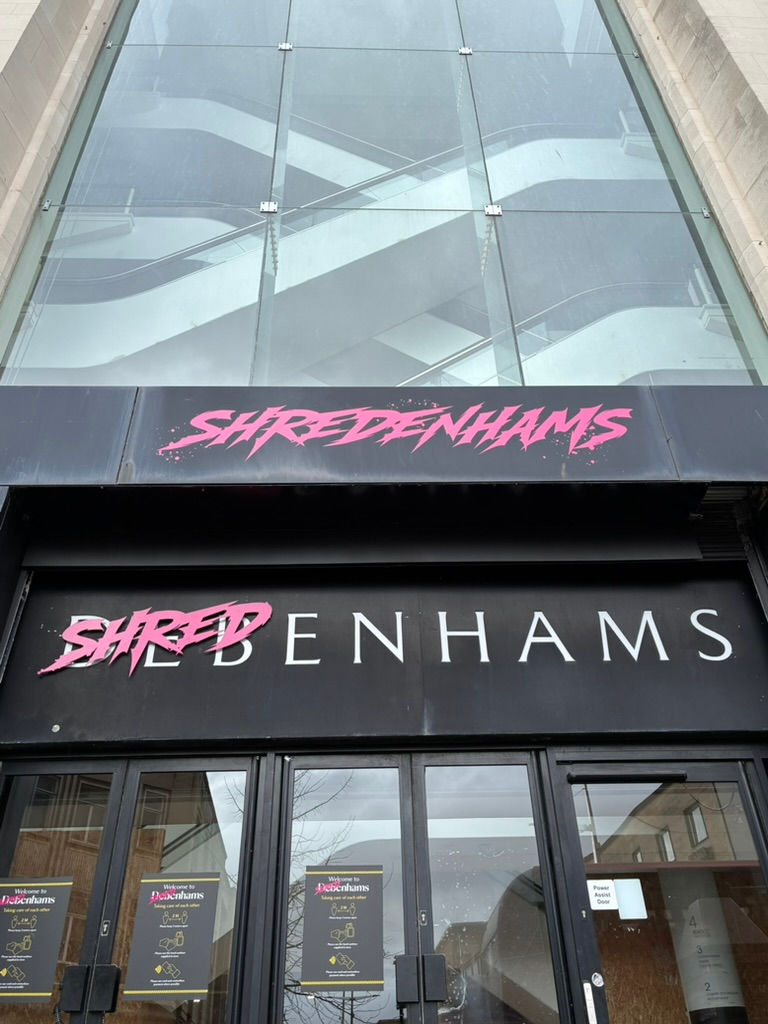
One particularly heartening trend we are witnessing is the innovative repurposing of defunct department stores. These grand Victorian and mid-century buildings were often architectural anchors and economic pillars. When they closed, they left voids, both physical and economic, in their high streets.
But creative solutions are emerging. In Bristol, Artspace Lifespace and the Global Goals Centre has transformed a department store into a vibrant mixed-use space, Sparks. Bobbys in Bournemouth and Havens in Southend-on-Sea offer similar examples of buildings being reimagined to serve multiple functions: market spaces, creative hubs, community centres, and hospitality venues.
Pay as much as you can meals at The Long Table, Cirencester, housed in a former department store
These projects represent more than clever adaptive reuse. They symbolise a fundamental shift in how we think about high streets: not as museums of retail traditions, but as living, evolving spaces responsive to real community needs.
The landlord question: a critical barrier
Despite these positive developments, significant structural barriers remain. Significant amongst these is the issue of landownership structures.
Disparate, distant, or sometimes entirely absent landlords create profound challenges. When property is owned by distant institutional investors with no stake in the community, or worse, when landlords are simply absent, local communities and councils struggle to develop a coherent vision for their high street or to curate an appropriate offer.
There is a deeper dynamic at play here. Landlords face an imperative to maintain the book value of their property portfolios on their balance sheets. This pressure can deter them from renting premises at rates that might more accurately reflect market reality. In some cases, they would rather leave a unit empty than accept rent they fear might set a precedent that devalues their wider portfolio or makes refinancing harder.
Landlords can be risk averse, lack knowledge of local economic conditions, intent on holding out for longer leases that they are unlikely to secure, and can suffer from a basic lack of local demand, particularly on already depressed high streets.,
These dynamics create vacancy, which creates blight, which creates the appearance of decline, which further depresses rents and investment. Breaking this cycle requires new approaches - new kinds of tenant, new forms of lease arrangement and more localised relationships.
One emerging tool gaining traction is the High Street Rental Auction, a local authority mechanism that, whilst expensive and administratively cumbersome to wield, allows councils to compel landlords to let premises under certain circumstances. Some early adopter councils have seen measurable success in reducing retail vacancy simply by engaging with landlords armed with the potential use of this power.
Whilst not a silver bullet, this tool represents a shift in thinking: from passive acceptance of landlord decisions to active community agency in shaping the high street.
The crucial role of place management
Throughout our work, we have observed that high street success is inextricably linked to the quality of place management. The tactics of place management have improved considerably in recent years, becoming more sophisticated and evidence-based.
But one factor consistently distinguishes the most successful initiatives: extensive local consultation and genuine community involvement.

Places that take time to listen genuinely and widely tend to make better decisions about investment, programming, and curating the business mix. They avoid top-down solutions that look good on paper but do not resonate with actual community life. They build genuine buy-in and ownership among residents.
Young people deserve particular attention in this process. When young people are involved in designing the vision for the places they will inherit, they develop a sense of ownership that extends far beyond the initial consultation process. They become champions for their high street's future, not because they have been told to, but because they have invested in its new shape.
Beyond engagement, place management is about developing skills, strong local partnerships and effective place leaders. There is no long term programme that assists with this, and that is a key barrier to transformation.
Some places are shaped via distant or cash-strapped councils, small numbers of exhausted volunteers and, single interest groups pulling in different directions. But when they work, places are directed by committed local governance, inspiring leaders and healthy partnerships.
The gap in central support
Despite all of this grassroots energy and innovation, there remains a significant gap in the system. Government policy increasingly emphasises longer-term transformation and community involvement, which is encouraging. But this support is unevenly distributed.

Many communities have simply not received grant funding or policy attention. They have been left without the central support or place management skills necessary to navigate the regulatory landscape, understand what interventions work, and implement change effectively.
This is why organisations like the former High Streets Task Force remain so crucial. Wide-scale place management skills support would help bridge the gap, enabling more communities to benefit from the lessons learned elsewhere and access professional guidance in developing their own high street strategies.
There is an opportunity in the High Streets Strategy to address the policy gap and set out the national; vision for High Streets. This cannot be an exercise in top-down, technocratic policymaking. Instead, the strategy much create the powers and conditions for local placemaking to proliferate.
The real story: a portrait of resilience
As we look towards the future, the real story of Britain's high streets is not one of terminal decline. Rather, it is a story of resilience, experimentation, and gradual reinvention.
Yes, some high streets face genuine economic headwinds. The retail landscape has fundamentally shifted, and entire categories of shops are unlikely to return. But the conditions for vibrant, diverse, community-focused high streets have arguably never been better. We have:
A clearer understanding of what makes places thrive
A growing movement of communities taking agency over their high street futures
An expanding toolkit of interventions, from place management strategies to property auctions
Successful examples we can learn from
A renewed recognition that high streets matter, not just economically, but socially and culturally
What comes next: practical pathways forward
For communities looking to strengthen their high streets, several principles emerge from our experience:
Start with understanding, not assumptions. What does your community actually need and want? What are the real economic and demographic realities of your catchment? What are your existing assets?
Build local leadership. High streets succeed when there are skilled, committed people driving change. Invest in developing place management capacity within your community.
Think diversity, not just retail. What mix of uses (hospitality, culture, community services, housing, innovation spaces) would strengthen your high street?
Consult extensively and genuinely. Do not just engage; truly listen. Include young people, businesses, residents, workers, and visitors. Be inclusive.
Take a long view. High street change happens across decades, not months. Set realistic expectations and celebrate incremental progress.
Learn from others. Connect with other communities facing similar challenges. Networks and peer learning multiply the effectiveness of local efforts.
Conclusion
The future of Britain's high streets is not predetermined. It is not a story of inevitable decline heading towards a pre-written ending. Instead, it is a story being rewritten right now by community groups, local authorities, business leaders, and residents across the country who are choosing to invest in their places.
These high streets may look different from the high streets of the past. They will host diverse uses. They will reflect the real needs and income levels of their catchments. They will be managed by skilled, community-engaged leaders. But they will also be vibrant, inclusive, resilient spaces where people genuinely want to spend time.
That is a future worth building towards. And across the country, we are already seeing it take shape.

BAS Consultancy helps communities, councils, placemakers and places make strategies to make their centres places to be proud of. You can contact Ben Stephenson at ben@basconsultancyhome.co.uk

Commercial cargo ships, passenger vessels, and offshore support ships may require higher-capacity systems capable of handling what is water quality monitoring large amounts of bilge water. Smaller boats and yachts often use compact units designed to fit within limited onboard space.
During colder months, undershirts provide a light layer of insulation without adding significant bulk. They are also useful for what is an undershirt individuals with sensitive skin because they create a barrier between the skin and rough fabrics.
This versatility allows couples to create rings that while showcasing the beauty of the radiant cut.
Meanwhile, solitaire asscher diamond rings emphasize cut and natural sparkle of the stone.